presents
For Internationally Educated Nurses
Your Nursing Journey To Yukon Starts Here.
Everything you need to go from nursing abroad to an RN licence from the Yukon Registered Nurses Association: the Inspire route every internationally educated nurse follows, the interim licence that lets you work under supervision while you finish, every fee we could confirm and who you pay, and the bonuses Yukon offers nurses. All in one place, in plain language.
See what is inside: get one year of access
Under federal rules, an employer of temporary foreign workers can’t make you pay to get or keep a job, and Yukon Nominee Program employers can’t pass recruiting costs on to you. See Staying safe from scams.
What’s inside.
This self-help information guide is two resources in one: your nursing roadmap to registration, and your encyclopedia of Canadian culture and daily life.
- Six clear steps, from your credential report to your yearly renewal, with a box to tick for each task.
- Yukon’s 2024 change explained: you can now apply directly in Yukon.
- The Inspire route: your credential report, English and the competence assessment, all handled in one place.
- The interim licence: how you can work under supervision for up to 3 years while you finish.
- Every fee and who you pay, with a budget worksheet that adds up your own costs.
- Bonuses and free help: where to ask about bonuses, and a navigation service that can fund some costs.
- Three hospitals and health centres in 13 communities, with rents and newcomer help.
- Scam warning signs and the mistakes that cost nurses time and money.
- Tools that do the math for you: a licensing budget, a monthly home budget, a home purchase calculator and a calendar tool that puts your deadlines in your phone.
- Yukon by the numbers: where newcomers live and come from, the nursing workforce, cost of living, weather and the health system, all on one page.
- First Weeks: 23 practical steps for your first weeks, from your SIN, bank account and phone to renting a home, your Yukon health card, school for your children and getting ready for winter.
Flags of Yukon.
The National Flag of Canada, the red and white flag with the maple leaf, flies across the whole country, in Yukon too.
Yukon’s own flag was adopted in 1967. It has three upright panels: green, white and blue. The white centre panel shows the territory’s arms and fireweed.
Official flower: fireweed, chosen in 1957.
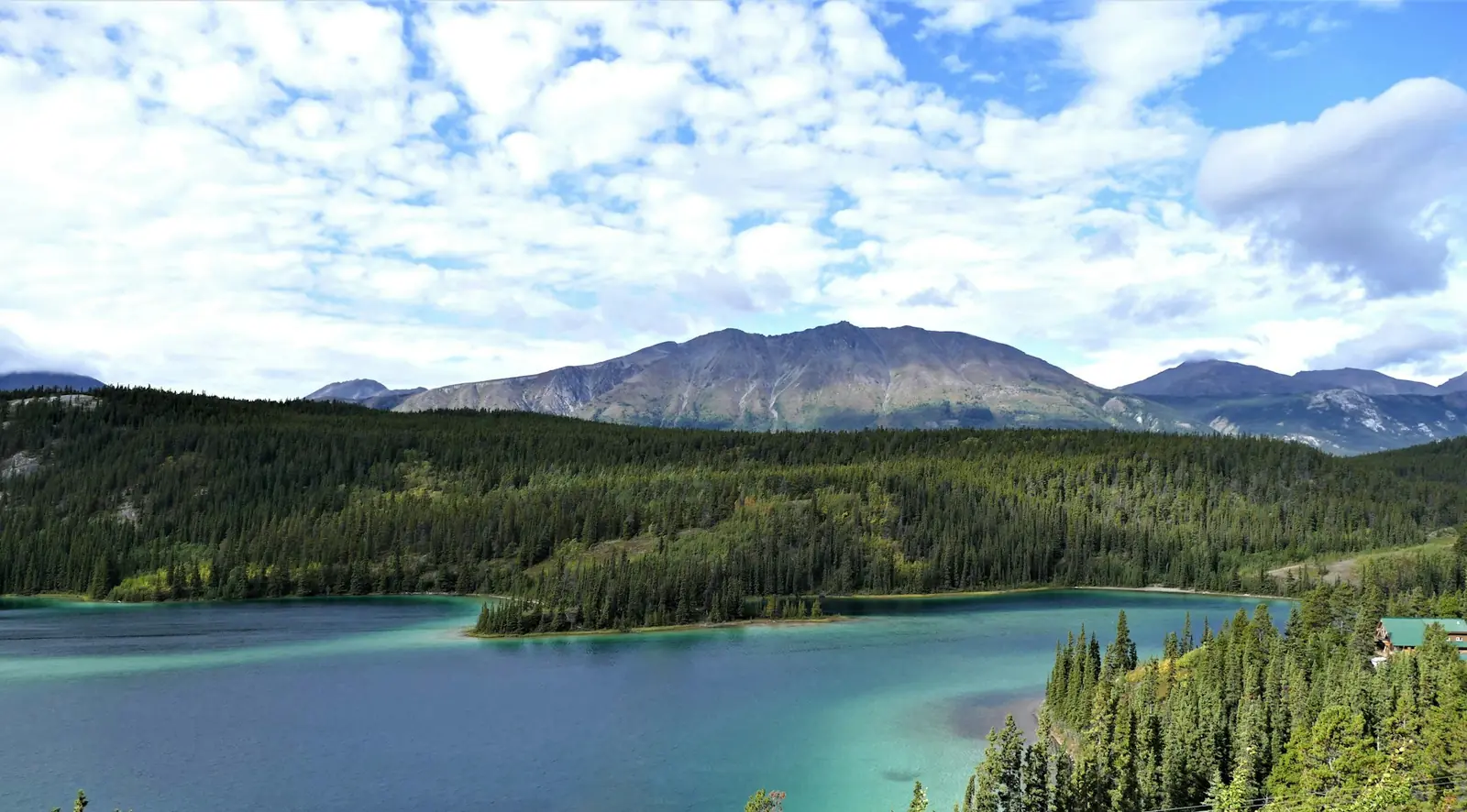
Geography of Yukon.
Here is the lay of the land, one part at a time.
Northwest: A narrow tundra plain meets the Beaufort Sea, backed by the British and Richardson mountains. Glacial ice never covered the British Mountains, and to the south lie the wetlands of Old Crow Flats.
Northeast: Steep ridges and narrow valleys of the Ogilvie, Wernecke and Selwyn mountains run along the Northwest Territories border. Arctic and alpine tundra cover the heights, with open taiga woodland to the south.
Centre: Rolling hills, plateaus and broad valleys of boreal forest fill the middle, with the Klondike Plateau along the Alaska border. The Yukon River flows past Whitehorse and Lake Laberge to Dawson.
Southwest: The St. Elias Mountains rise along the Alaska boundary, holding the world’s largest non-polar icefields. Snow and ice cover more than half of Kluane National Park and Reserve.
Southeast: The Pelly and Cassiar mountains and the wide Liard Basin reach the British Columbia border, with forests of pine, spruce and aspen in the low country.
Fun Facts.
Ten things that make Yukon one of a kind.
- The Sign Post Forest. In 1942, injured U.S. Army engineer Carl Lindley was repairing directional posts in Watson Lake when he added a sign for his hometown of Danville, Illinois. Travellers kept up the idea, and the forest now holds close to 100,000 markers. Visitors can still add their own. Source: Travel Yukon.
- A Wooden Ladder for Salmon. Yukon Energy says the Whitehorse fish ladder is the longest wooden fish ladder in the world. It lets fish pass safely around the Whitehorse Rapids Dam. Since 2023, its viewing chamber gates have stayed open all day and night, and a camera counts the salmon. Source: Yukon Energy.
- Whitehorse’s Log Skyscrapers. In 1947, Martin Berrigan built double and triple-decker log buildings on Lambert Street for workers and military personnel. Travel Yukon calls them the world’s first log skyscrapers and the only buildings of this type in Canada. They are still used as apartments today. Source: Travel Yukon.
- The Tiniest Desert. Travel Yukon bills the sandy dunes at Carcross as the world’s tiniest desert. They formed over 10,000 years ago when a glacial lake dried up and left its sandy bottom exposed. People sandboard here in summer and toboggan in winter. Source: Travel Yukon.
- Nun Cho Ga, the Baby Mammoth. In June 2022, a mummified baby woolly mammoth named Nun Cho Ga was found on Upper Eureka Creek. Yukon Geological Survey staff helped recover it. They also joined a Tr’ondëk Hwëch’in First Nation ceremony marking the importance of the discovery. Source: Yukon Geological Survey, via Government of Canada Open Government Portal.
- The Giant Gold Dredge. Dredge No. 4 sits in the Klondike Goldfields outside Dawson City, standing 18 metres high. It captured 9 tons of gold in its working life and still holds the title of largest wooden-hulled dredge in North America. Visitors to this National Historic Site can view it from below or join a guided tour. Source: Travel Yukon.
- Canada’s Highest Mountain. Mount Logan in Kluane National Park and Reserve rises 5,959 metres, making it the highest mountain in Canada. It is also the second-highest peak on the continent. The nearby St. Elias Icefields, among the world’s largest non-polar icefields, can be up to 1 km deep. Source: Parks Canada.
- The Beer Bottle House. Geordie Dobson, former owner of the Keno City Hotel, covered his house in 32,000 empty beer bottles. He said it was practical, since the bottles insulate well against Keno’s cold. He no longer lives in Keno, but the house still stands. Source: Travel Yukon.
- Yukon’s First Territorial Park. Herschel Island, or Qikiqtaruk, became Yukon’s first territorial park in 1987. The name means "it is island" in the Inuvialuit language, and the island has been a hunting and fishing area for thousands of years. American whalers used its harbour as a base in the late 1800s. Source: Travel Yukon.
- The Plane That Became a Wind Vane. A retired DC-3 airplane, CF-CPY, has served as a giant wind vane in Whitehorse since 1981. Thanks to a local welder’s idea, it pivots on its pedestal so its nose always points into the wind. It moved to the front of the Yukon Transportation Museum in 2009. Source: Yukon Transportation Museum.
Checked against official sources in fall 2026.