presents
For Internationally Educated Nurses
Your Nursing Journey To Prince Edward Island Starts Here.
Everything you need to go from nursing abroad to an RN licence from the Prince Edward Island College of Nursing and Midwifery: the one route every internationally educated nurse follows, the free transition program, every fee and who you pay, and the dates that trip people up. All in one place, in plain language.
See what is inside: get one year of access
Since April 1, 2025, PEI law says a recruiter may not charge a foreign worker any fee for recruitment or for getting a job, and anyone paid to recruit for PEI needs a provincial licence. If someone asks you to pay to be placed in a PEI nursing job, say no and report it. See Staying safe from scams.
What’s inside.
This self-help information guide is two resources in one: your nursing roadmap to registration, and your encyclopedia of Canadian culture and daily life.
- Six clear steps, from your NNAS report to your yearly renewal, with a box to tick for each task.
- Prince Edward Island’s 2026 change explained: one new College for RNs, LPNs, psychiatric nurses and midwives.
- The free transition program: what it is, who it’s for, and how you can work under supervision while you finish it.
- Every fee and who you pay, with a budget worksheet that adds up your own costs.
- Your NCLEX-RN plan: three tries within a year if you’re on provisional registration, and the fee rise coming in February 2027.
- Six hospital towns across the Island, with their hospitals, rents and newcomer help.
- Scam warning signs and the mistakes that cost nurses time and money.
- Tools that do the math for you: a licensing budget, a monthly home budget, a home purchase calculator and a calendar tool that puts your deadlines in your phone.
- Prince Edward Island by the numbers: where newcomers live and come from, the nursing workforce, cost of living, weather and the health system, all on one page.
- First Weeks: 23 practical steps for your first weeks, from your SIN, bank account and phone to renting a home, your PEI health card, school for your children and getting ready for winter.
Flags of Prince Edward Island.
The National Flag of Canada, the red and white flag with the maple leaf, flies across the whole country, in Prince Edward Island too.
Prince Edward Island’s own flag received a royal warrant from King Edward VII in 1905 and was approved by the legislature in 1964. It is modelled on the coat of arms, with a border of red and white bands.
Official flower: the lady’s slipper, adopted in 1947.
Motto: “Parva sub ingenti”, meaning “The small under the protection of the great”.
Geography of Prince Edward Island.
Here is the lay of the land, one part at a time.
Whole island: A crescent about 230 kilometres long lies in the Gulf of St. Lawrence, with the Northumberland Strait between it and New Brunswick and Nova Scotia. Forest and farmland cover most of it, about 43 and 38 percent in 2020.
West: The west is lower than the rest of the Island, and its shoreline has the Island’s highest share of cliffs and bluffs.
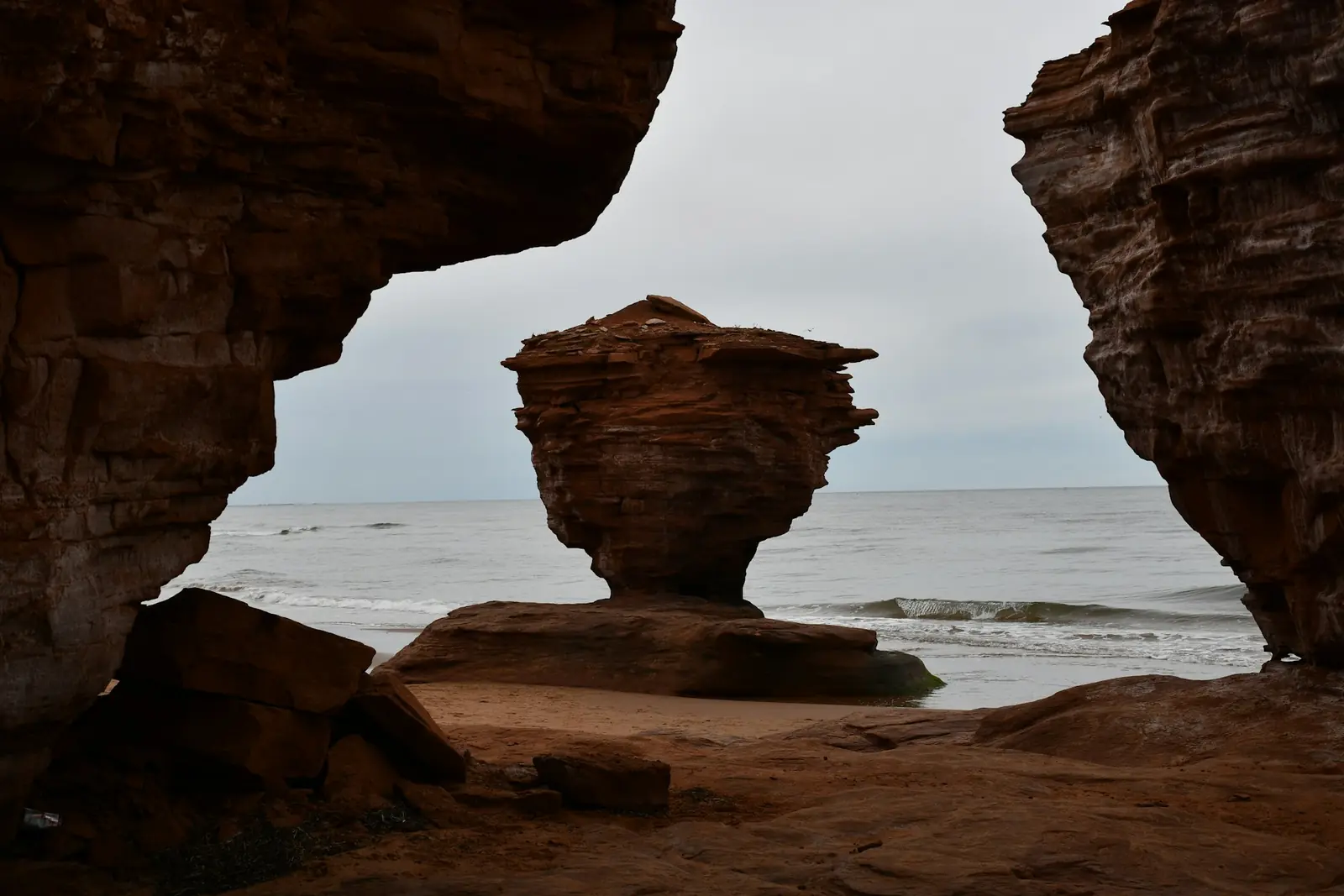
Centre and east: Rolling hills are highest here, with the peak of 142 metres above sea level in the south-central part. Soil is a thin layer of glacial material over weathered red sandstone.
North shore: Sand beaches and dunes line this shore, with marram grass holding the sand together. The Malpeque barrier chain alone runs 43 kilometres, and sheltered ponds form behind the dunes.
South shore: This more sheltered side holds many salt marshes. The Island’s highest cliffs, about 35 metres of red sandstone, stand at Orwell Bay.
Did you know? Bays and estuaries, once river valleys before rising seas flooded them, give this 230-kilometre island about 3,280 kilometres of coastline.
Fun Facts.
Ten things that make Prince Edward Island one of a kind.
- Houses Made of Bottles. A postcard of a glass castle, sent by his daughter in 1979, inspired Édouard T. Arsenault. From 1980 until spring 1984, he cemented over 25,000 bottles into three colourful buildings. The first one opened to the public in 1981. Source: The Bottle Houses.
- Bridge Over Icy Water. The Confederation Bridge links Prince Edward Island to New Brunswick. At 12.9 kilometres, it is the world’s longest bridge over ice-covered water, according to its operator. It began carrying vehicles on May 31, 1997. Source: Confederation Bridge.
- The Real Green Gables. Lucy Maud Montgomery published her novel Anne of Green Gables in 1908, drawing inspiration from a Cavendish farmstead. Anne is fictional, but visitors can tour Green Gables House and see the setting for her adventures. It is a Parks Canada site open from May to October. Source: Parks Canada.
- A Bank Run by Farmers. Built between 1861 and 1863, the Farmers’ Bank of Rustico housed one of Canada’s first people’s banks. It received a charter in 1864, and local farmers and fishermen directed it until 1894. The building is now a national historic site. Source: Parks Canada.
- Singing Sands and Giant Moss. Basin Head is known for its Singing Sands. It is also one of Canada’s Marine Protected Areas, sheltering a giant Irish moss that grows only in this lagoon. Guided 90-minute tours explain why the sand sings. Source: Tourism PEI.
- Dunes on the Move. Greenwich has the biggest sand dunes on Prince Edward Island, unusually large parabolic dunes that move over time. A floating boardwalk carries hikers across the area. Archaeological digs here found traces of cultures spanning 10,000 years. Source: Parks Canada.
- The Silver Fox Pioneers. Between 1880 and 1910, near Alberton, Robert T. Oulton and Charles Dalton pioneered raising silver black foxes in captivity. Their animals became foundation stock for ranches in North America, Europe and Asia. A national historic plaque marks the story. Source: Parks Canada.
- Where Two Waters Crash Together. North Cape claims the longest natural rock reef in North America, running about two kilometres offshore. At low tide you may spot seals. When the tide rises, the Gulf of St. Lawrence and the Northumberland Strait crash together. Source: North Cape PEI.
- The Island’s Oldest Lighthouse. Built in 1845, Point Prim is the oldest lighthouse on Prince Edward Island and one of Canada’s oldest surviving towers. It stands 18.3 metres tall. Its secret is that the tapered brick tower hides under a covering of wood shingles. Source: Parks Canada.
- A Very Big Potato. O’Leary’s Canadian Potato Museum claims the world’s largest exhibit of potato-related farm machinery and artifacts. Visitors can also pose with what it calls the world’s largest potato sculpture. The museum is seasonal and open from spring to fall. Source: Canadian Potato Museum.
Checked against official sources in fall 2026.