presents
For Internationally Educated Nurses
Your Nursing Journey To New Brunswick Starts Here.
Everything you need to go from nursing abroad to an RN licence from the College of Nursing of New Brunswick: the five country zones and which one is yours, every fee and who you pay, the provincial help with costs, and the deadlines that catch people out. All in one place, in plain language.
See what is inside: get one year of access
What’s inside.
This self-help information guide is two resources in one: your nursing roadmap to registration, and your encyclopedia of Canadian culture and daily life.
- Six clear steps, from finding your zone to your yearly renewal, with a box to tick for each task.
- New Brunswick’s 2026 changes explained: the regulator’s new name and the new five-zone pathway from July 2026.
- Every fee and who you pay, with a budget worksheet that adds up your own costs.
- Provincial help with costs: who qualifies, and why to ask before you pay anything.
- The temporary registration permit: how to work while you finish your courses and write the NCLEX-RN.
- Eight New Brunswick hospital cities, with their hospitals, weather, rent and newcomer centres.
- Scam warning signs and the mistakes that cost nurses time and money.
- Tools that do the math for you: a licensing budget, a monthly home budget, a home purchase calculator and a calendar tool that puts your deadlines in your phone.
- New Brunswick by the numbers: where newcomers live and come from, the nursing workforce, cost of living, weather and the health system, all on one page.
- First Weeks: 23 practical steps for your first weeks, from your SIN, bank account and phone to renting a home, your Medicare card, school for your children and getting ready for winter.
Flags of New Brunswick.
The National Flag of Canada, the red and white flag with the maple leaf, flies across the whole country, in New Brunswick too.
New Brunswick’s own flag was adopted by proclamation in 1965. Its design is based on the provincial coat of arms.
Official flower: the purple violet, adopted in 1936.
Motto: “Spem reduxit”, meaning “Hope restored”.
Geography of New Brunswick.
Here is the lay of the land, one part at a time.
Northwest: The Madawaska Uplands begin at the provincial panhandle and curve south, with the Maine border and the upper Saint John River valley on the western side. Balsam fir is especially common here.
Northeast: Two high areas form the Highlands, with a northern forest feel and the Tobique, Miramichi and Nepisiguit rivers starting there. Drier uplands arc along Chaleur Bay, and flatter land begins at Bathurst.
Southwest: The Saint John River valley lowlands, the largest and most varied region, reach down to Passamaquoddy Bay near Maine. The cool Fundy coast runs east from there.
Southeast: Flat to gently rolling lowlands reach Sackville, with peatlands inland and sand dunes, salt marshes and lagoons along the Northumberland Strait. The Caledonia Uplands, a broad plateau, run beside the Bay of Fundy.
Centre: The Grand Lake basin and the floodplains of the lower Saint John River have New Brunswick’s warmest climate. Forested wetlands flood with rich silt, and southern plants thrive.
Fun Facts.
Ten things that make New Brunswick one of a kind.
- Shediac’s Giant Lobster. Shediac’s Rotary Club commissioned this concrete lobster, a nod to the town’s title of Lobster Capital of the World. Sculptor Winston Bronnum’s work is 10.7 metres long, five metres high and weighs 90 tonnes. It was unveiled on June 30, 1990. Source: Town of Shediac.
- The Longest Covered Bridge. Hartland claims the longest covered bridge in the world, at 1,282 feet. It officially opened on July 4, 1901, without a roof. The cover only went on in 1922, after major repairs by the government. Source: Town of Hartland.
- The Largest Axe. Guinness World Records lists a steel axe presented to the town of Nackawic as the largest axe. Its entry, dated May 11, 1991, gives a length of 18.28 metres, a width of 7 metres and a weight of 7 tonnes. BID Ltd of Woodstock designed and built it. Source: Guinness World Records.
- Canada’s Chocolate Town. Ganong has been making candy in St. Stephen since 1873, and the town was named Canada’s Chocolate Town in 2000. The Chocolate Museum, in the original factory, credits the company with Canadian firsts such as heart-shaped boxes and Chicken Bones candy. Source: The Chocolate Museum.
- The Coleman Frog. An 1899 magazine article saved by the Fredericton Region Museum tells of Mr. Coleman’s pet frog, found at Lake Killarney in 1887. Fattened on a cornmeal mix, it was said to reach 42 pounds. After it died, its hide was mounted, and the frog’s fame lives on. Source: Fredericton Region Museum.
- A Park Owned by Two Countries. Roosevelt Campobello International Park sits on Campobello Island. The Government of Canada calls it the only park in the world owned by the peoples of two countries. A joint commission set up under a 1964 Canada-U.S. agreement runs it. Source: Government of Canada.
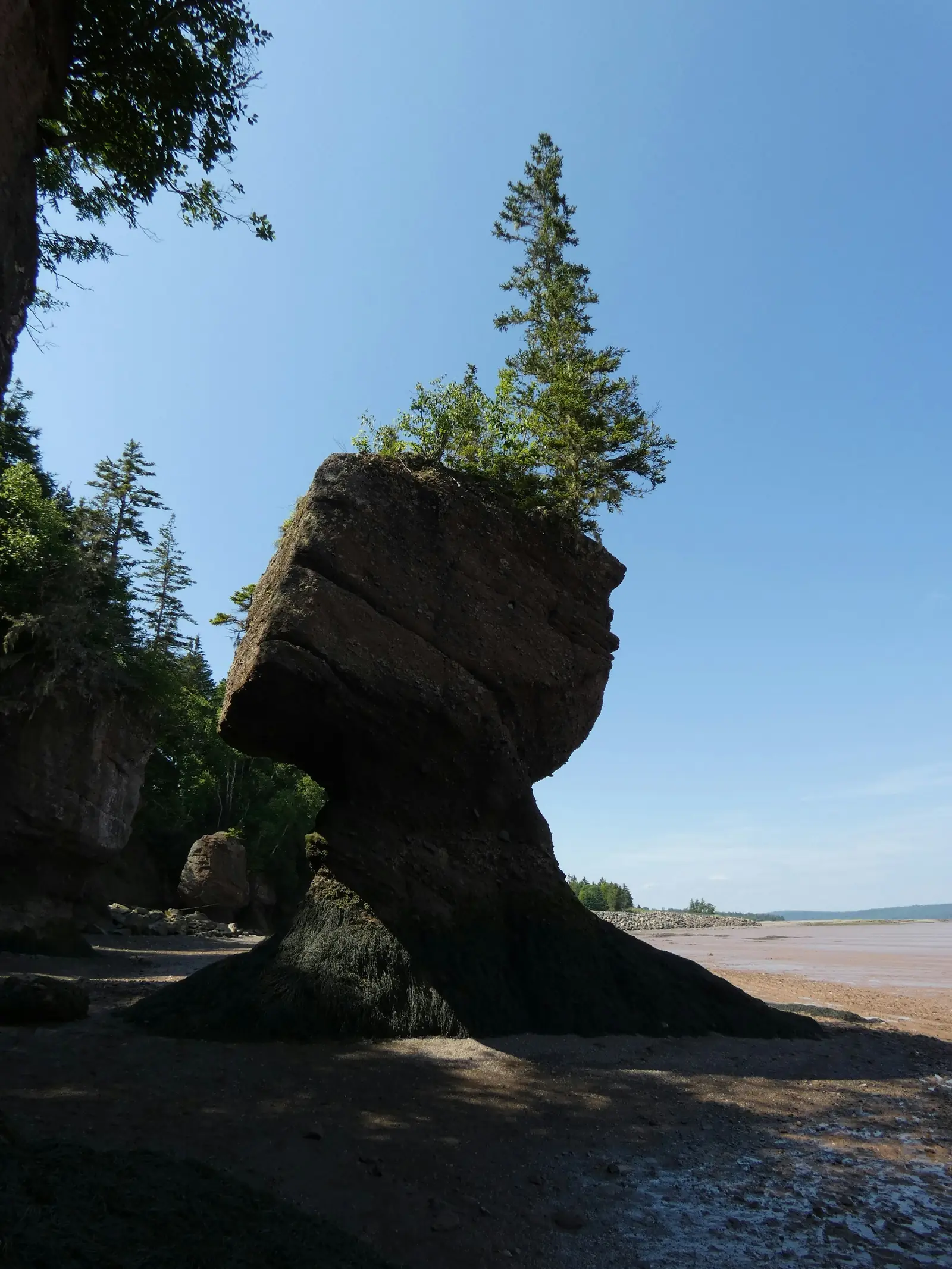
- The Flowerpot Rocks. The sea stacks at Hopewell Rocks are nicknamed flowerpots, and they come in many shapes and sizes. When the Bay of Fundy tide goes out, visitors can walk the ocean floor around them, so checking tide times first is a must. Source: New Brunswick Provincial Parks.
- The River That Runs Backwards. At Reversing Falls, the rising Bay of Fundy tide forces the St. John River to flow backwards. The geopark says this effect is only about 3,000 years old, although the surrounding rocks are hundreds of millions of years old. Source: Stonehammer UNESCO Global Geopark.
- Magnetic Hill. At the foot of Lutes Mountain, the slopes create an illusion that cars and even running water travel uphill. Local farmers knew about it in the 1800s, but an August 1933 Telegraph-Journal article first made it widely known and started the tourism. Source: Canada’s Historic Places.
- The Top of the Maritimes. A tower on the summit of Mount Carleton marks the highest point in the Maritime provinces. It was once used to watch for forest fires. Hikers reach it on a 9.6 km loop trail, crossing a long, rocky ridge to the peak. Source: New Brunswick Provincial Parks.
Checked against official sources in fall 2026.