presents
For Internationally Educated Nurses
Your Nursing Journey To Alberta Starts Here.
Everything you need to go from nursing abroad to a CRNA practice permit: every fee and who you pay, the deadlines that catch people out, and local help in eight Alberta communities. All in one place, in plain language.
See what is inside: get one year of access
What’s inside.
This self-help information guide is two resources in one: your nursing roadmap to registration, and your encyclopedia of Canadian culture and daily life.
- Six clear steps from choosing RN or LPN to renewing your first permit, with a box to tick for each task.
- Every fee and who you pay, with a budget worksheet that adds up your own costs.
- Key dates in your calendar: NCLEX deadlines, document expiry and renewal windows.
- A map of eight Alberta communities with hospitals, free newcomer services and cultural groups.
- Scam warning signs and the mistakes that cost IENs time and money.
- Tools that do the math for you: a licensing budget, a monthly home budget, a home purchase calculator and a calendar tool that puts your deadlines in your phone.
- Alberta by the numbers: where newcomers live and come from, the nursing workforce, compensation, cost of living, weather and the health system, all on one page.
- First Weeks: 23 practical steps for your first weeks, from your SIN, bank account and phone to renting a home, your health card, school for your children and getting ready for winter.
Flags of Alberta.
The National Flag of Canada, the red and white flag with the maple leaf, flies across the whole country, in Alberta too.
Alberta’s own flag was first used in 1967 and officially adopted in 1968. It shows the province’s shield of arms in the centre of a royal ultramarine blue background.
Official flower: the wild rose, also called the prickly rose, since 1930.
Motto: “Fortis et liber”, meaning “Strong and free”.
Geography of Alberta.
Here is the lay of the land, one part at a time.
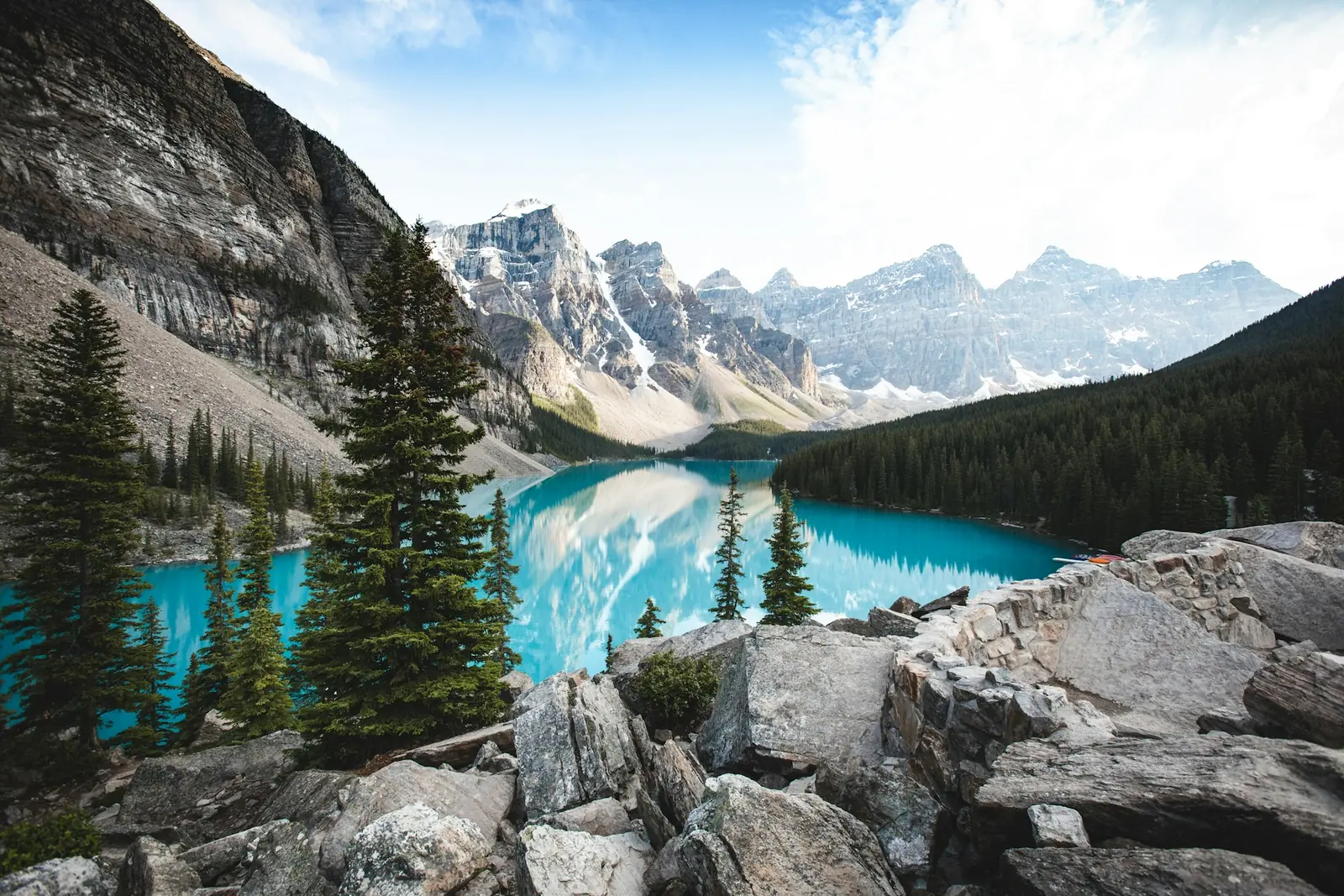
Southwest: The Rocky Mountains follow the British Columbia border, with forested foothills on their eastern side north of the Bow Valley. Farther south, the prairie meets the peaks at Waterton Lakes National Park.
Southeast: This is Alberta’s prairie, level to gently rolling grassland and the warmest, driest part of the province. It runs from the foothills to Saskatchewan and south to Montana, with the Cypress Hills rising above it.
Centre: Parkland, a mix of aspen groves and fescue grassland, arches north from Calgary through Edmonton and east to Saskatchewan. Much of it is now farmland, and it is the most densely populated part of Alberta.
Northwest: Boreal forest and wetlands cover most of the land, with high plateaus in the far north. Along the Peace River, a small area of parkland and farmland lies near Grande Prairie, well north of the main parkland.
Northeast: Boreal forest, wetlands and lakes reach the Northwest Territories border, along with sand plains and the Peace-Athabasca Delta. The far northeast is rocky Canadian Shield, Alberta’s smallest natural region.
Did you know? Mount Columbia, shared with British Columbia, tops Alberta at 3,747 metres.
Fun Facts.
Ten things that make Alberta one of a kind.
- A T. rex You Can Climb. Tyra, a giant T. rex in Drumheller, stands 86 ft tall and claims the title of World’s Largest Dinosaur. Visitors can climb 106 stairs lined with murals. Source: Travel Alberta.
- The Giant Pysanka. Vegreville’s huge Ukrainian Easter egg stands 31 feet high, and the town bills it as the world’s largest pysanka. The local Chamber of Commerce built it to mark Ukrainian culture and the RCMP’s centennial. Queen Elizabeth and Prince Philip came to see it in 1978. Source: Town of Vegreville.
- A Landing Pad for Aliens. St. Paul built a 9-metre-wide concrete UFO landing pad as a 1967 Canadian Centennial project, and Guinness World Records calls it the first official one on Earth. Its backstop is a map of Canada made with stones from each province. A time capsule beneath it waits until 2067. Source: Guinness World Records.
- Starship Town. Vulcan unveiled a replica of the Starship Enterprise on June 10, 1995, naming it FX6-1995-A after the local airport code. Its tourist centre, opened in 1998, was designed to look like a landed spaceship. Leonard Nimoy visited in 2010, and a bronze Spock bust and his handprint mark the occasion. Source: Town of Vulcan.
- A Tepee 20 Storeys High. Medicine Hat’s Saamis Tepee was first built for the 1988 Calgary Winter Olympics, and the city calls it the World’s Tallest Tepee. Its main masts reach 215 feet, about the height of a 20-storey building. Ten large storyboards share Indigenous culture and history. Source: City of Medicine Hat.
- The Boulder That Rode a Glacier. Big Rock near Okotoks is a 16,500-tonne boulder, about 41 metres long and 9 metres tall. It fell from a mountain in today’s Jasper National Park onto a glacier, which carried it to the prairie. Its name comes from the Blackfoot word for rock. Source: Government of Alberta.
- A Record Trestle Bridge. Lethbridge’s High Level Bridge was finished in June 1909, running 1,624 metres across the coulees and rising 96 metres above the river. The city claims it remains the longest and highest trestle bridge in the world. It replaced 20 wooden bridges on the old rail line. Source: City of Lethbridge.
- Canada’s Biggest National Park. Wood Buffalo National Park, established in 1922 to protect free-roaming bison, is Canada’s largest national park. It also holds the last natural nesting area of the endangered whooping crane. UNESCO made it a World Heritage Site in 1983. Source: Parks Canada.
- The World’s First Peace Park. In 1932, Canada and the United States joined Waterton Lakes and Glacier national parks into the world’s first international peace park. Rotary Clubs from Alberta and Montana championed the idea. UNESCO named it a World Heritage Site in 1995. Source: U.S. National Park Service.
- The Hot Springs That Started It All. In 1883, three railway workers, Frank McCabe and brothers Tom and William McCardell, stumbled upon thermal springs at what is now Cave and Basin. Their find set off the events that created Canada’s first national park, Banff. The site is now a national historic site. Source: Parks Canada.
Checked against official sources in fall 2026.